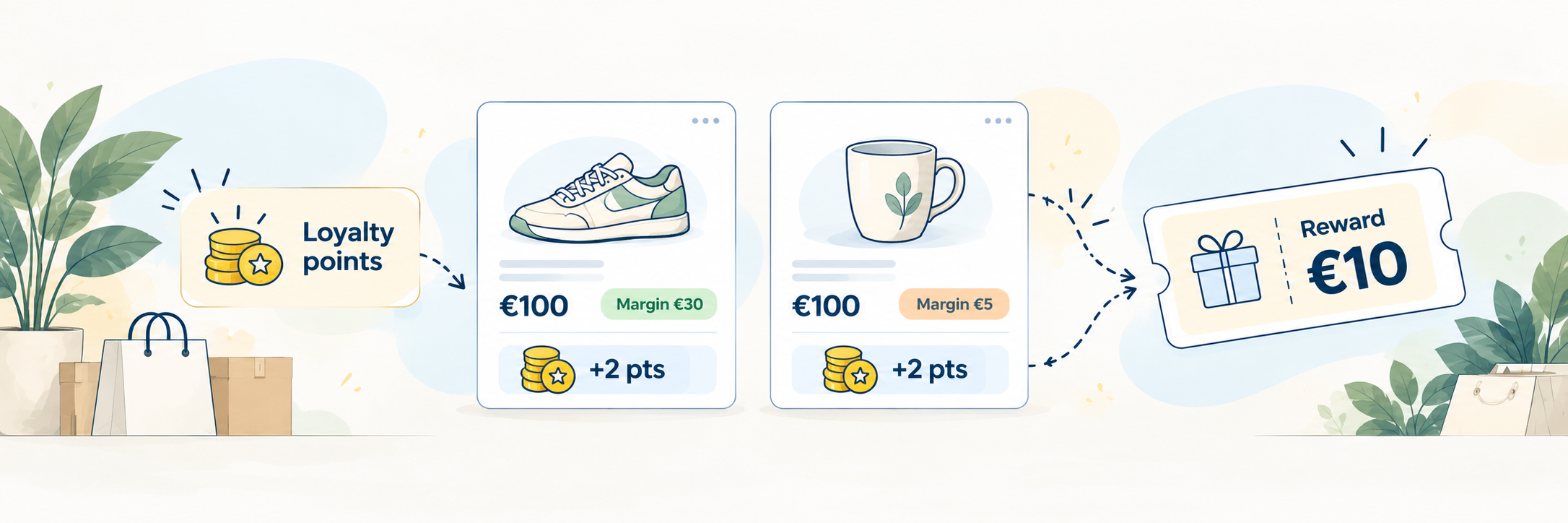
Not every order in a PrestaShop store needs to earn loyalty points. If products have different profit margins, rewarding every purchase at the same rate can make some orders much less profitable. Before launching a loyalty program, it’s worth deciding which purchases should earn points, how much those points are worth, and when customers can use them.
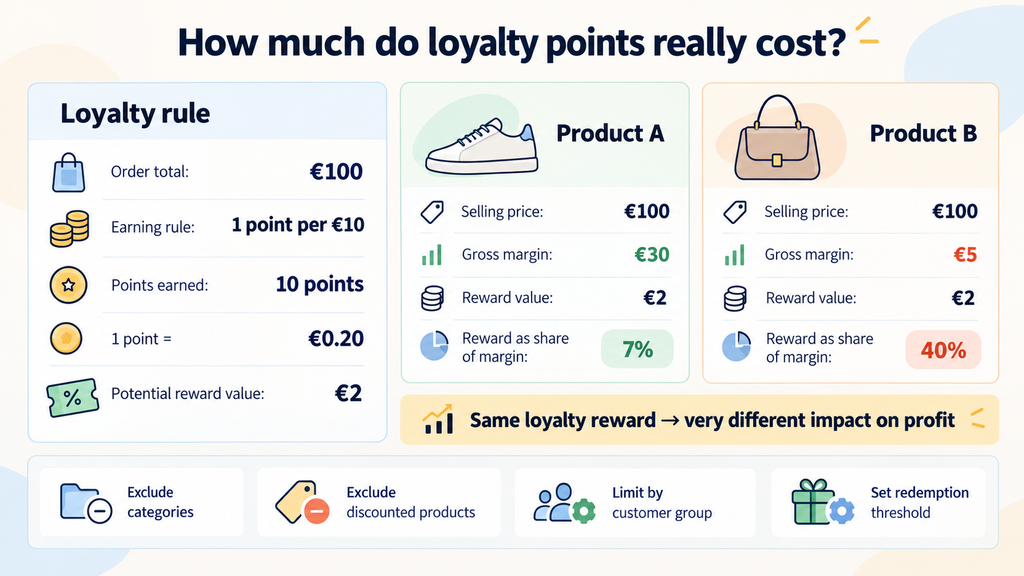
Let’s say your store gives customers one point for every €10 spent. Each point is worth €0.20 when converted into a discount voucher.
That means a €100 order earns €2 in potential rewards.
Sounds reasonable, doesn’t it?
But now imagine two products that both cost €100. One leaves you €30 in gross profit before rewards. The other leaves only €5.
Both generate the same €2 reward. If the points are eventually redeemed, that’s a small part of the first product’s margin, but 40% of the second one’s.
Suddenly, rewarding every purchase doesn’t look quite so simple.
Not every product has room for loyalty points
I think this is one of the first things worth checking before setting up a loyalty program.
A store might sell products with very different margins. Some are profitable enough to support additional rewards. Others are already priced competitively, with little room left for discounts.
And what about products that are already on sale?
If a customer buys something at 20% off and also earns loyalty points, you’re effectively adding another future discount on top of the current one.
That might be perfectly fine for some promotions. But it should be a deliberate decision, not something that happens automatically.
One approach is to exclude discounted products or entire low-margin categories from earning points.
This is one of the problems I wanted to address with my Advanced Loyalty Points module for PrestaShop. It lets store owners exclude products already on sale, choose which categories participate, and limit point earning to selected customer groups. I prefer giving stores control over these rules rather than assuming every purchase should be rewarded in exactly the same way.
Of course, exclusions need to be clear to customers too. Nobody wants to discover after checkout that a product they expected to earn points on wasn’t eligible.
Should every customer earn the same rewards?
Here’s another question.
Suppose your store sells to both retail customers and wholesale buyers.
A retail customer places a €100 order. A wholesale customer places a €1,000 order, but receives special pricing with a much smaller margin.
Should both earn loyalty points at the same rate?
Not necessarily.
You might want loyalty points only for retail customers. Or you might have different customer groups with different purchasing arrangements.
The point is not to make the program complicated. It’s to avoid applying the same incentive to customers whose orders have very different economics.
And then there are VIP tiers.
I like the idea of giving loyal customers something to work toward. Instead of just collecting points indefinitely, they can reach a milestone and receive an additional reward.
For example, reaching 250 points could unlock a €10 voucher.
But remember that this voucher also has a cost. If customers can both redeem their accumulated points and receive milestone rewards, you need to consider the value of both.
A VIP program should reward loyalty, not quietly give away more margin than you intended.
What happens to points after customers earn them?
Earning points is only half of the loyalty program.
At some point, customers will want to use them.
Should they be able to convert five points into a voucher? Or should they collect at least 100 first?
A minimum redemption threshold can be useful, but I wouldn’t set it so high that an occasional customer has almost no chance of reaching it.
The same goes for expiration dates.
Points that expire after a certain period can encourage customers to return. But if the deadline is too short, the reward starts feeling less like a benefit and more like a trick.
I’d rather give customers a reasonable amount of time and remind them before their points expire.
There’s also the question of cancelled or returned orders.
If points were earned from a purchase that was later refunded, should those points remain available?
Usually, you’d want the reward to follow the final order status. Otherwise, the store could end up rewarding purchases it never actually kept.
These details aren’t particularly exciting, but they matter when a loyalty program starts handling real orders.
Why use points instead of an ordinary coupon?
You could just give customers a discount coupon after every purchase.
So why bother with points?
To me, the main difference is that loyalty points give customers something to accumulate.
A coupon is usually a specific offer: here’s €10 off your next order.
Points work differently. A customer earns a little from one purchase, a little more from another, and eventually has enough to exchange them for a voucher.
That gives the customer a visible balance that can grow over time.
It also gives the store more flexibility over when the reward becomes available and how much customers need to collect before using it.
Neither approach is automatically better. If you only want to offer an occasional discount, a coupon may be enough.
But if you want customers to build up rewards across several purchases, points make more sense.
I’ve written separately about whether a coupon can actually bring a customer back. That’s a slightly different question from deciding how much a loyalty program should cost your store.
Start with the cost, not the points
It’s tempting to start a loyalty program by choosing an attractive earning rate.
One point for every euro. Ten points for every order. Double points on weekends.
Those are easy numbers to come up with.
The more useful question is what those points will cost when customers actually redeem them.
I’d start with a few real orders from the store. Look at their margins, calculate the potential reward value, and check what happens if customers also use other discounts.
Then decide which products and customers should participate, how points can be redeemed, and whether additional tier rewards make financial sense.
You don’t need an elaborate VIP program from day one.
A simple loyalty program with sensible rules is a better starting point than a generous one you later discover you can’t afford.