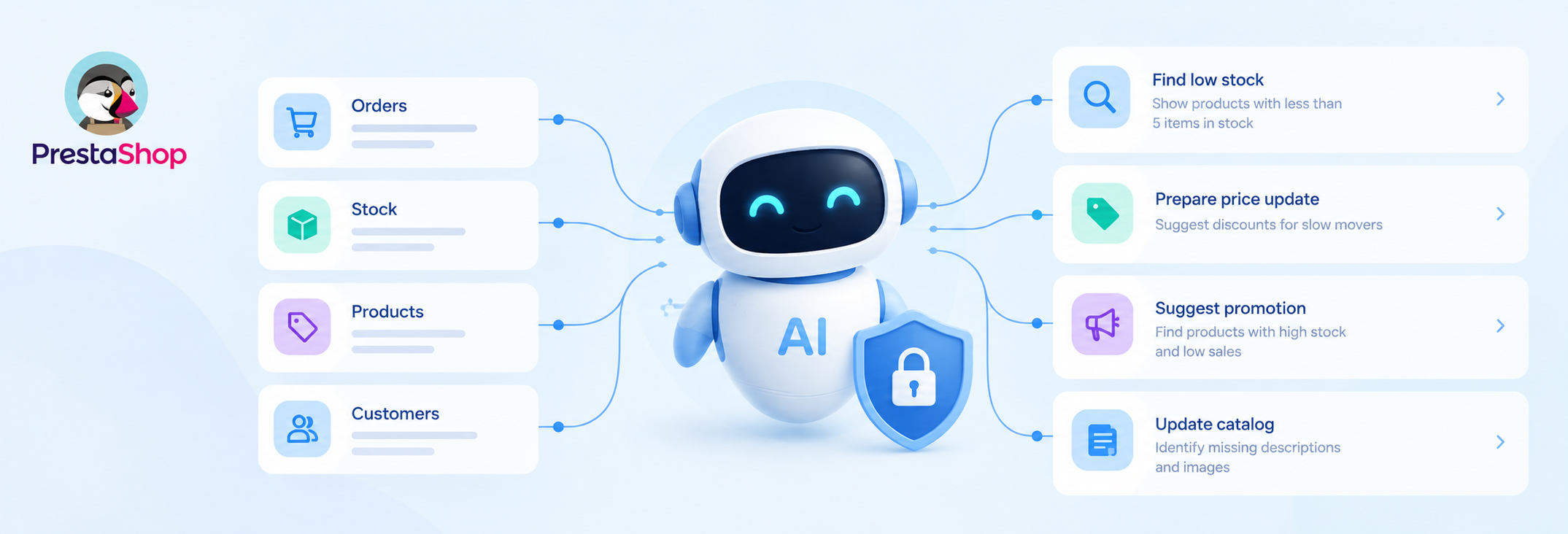
Most AI demos for e-commerce start with a chatbot.
You ask:
“Which products are running low on stock?”
and the AI gives you an answer.
Useful — but not very different from a smarter search box.
The more interesting question starts when the AI can actually interact with the store.
Should it be allowed to change a price? Update stock? Create a discount? Refund an order?
That is where an AI assistant becomes an AI agent — and where things get more complicated.
Start with tasks that are annoying, not dangerous
If I were connecting an AI agent to a PrestaShop store, I would start with read-only tasks.
For example, I could ask:
“Show me products with fewer than five items in stock that sold at least ten units last month.”
Or:
“Find active products that have no description, no image or no sales in the last 90 days.”
These are useful because the agent can combine information that normally requires several pages, filters or exports.
It is not making a business decision yet. It is helping me find where a decision is needed.
That seems like a much better first use case than letting an AI automatically rewrite the entire catalog.
The next step is preparing actions
A slightly more powerful agent could do more than find problems.
Imagine asking:
“Find slow-moving products with high stock and suggest candidates for a promotion.”
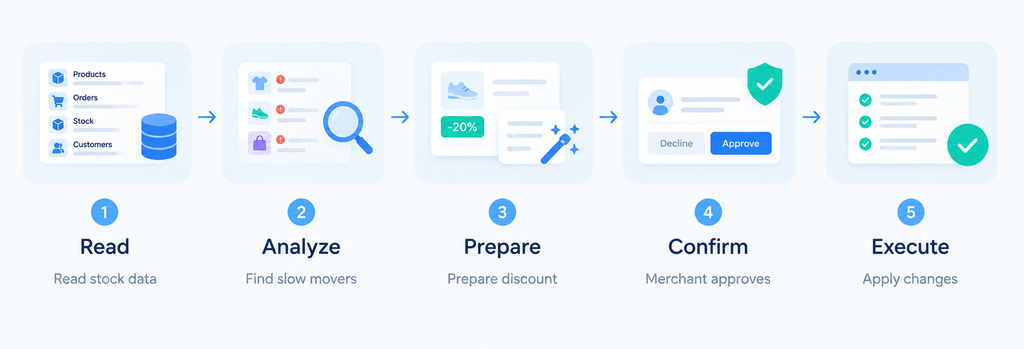
The agent could inspect sales and stock data, produce a shortlist and suggest a discount.
But I would still want a human to approve the actual price change.
The same pattern works for many tasks:
The agent can prepare a catalog cleanup, draft new descriptions, identify products that need attention, calculate possible discounts or prepare a list of stock updates.
AI does the tedious part.
The merchant keeps the final decision.
Some actions deserve a confirmation button
Changing one product description is relatively easy to undo.
Refunding an order is different.
So is changing prices for 500 products or sending a message to thousands of customers.
I would be much more cautious with actions involving money, customers or large batches of data.
An agent could still prepare them:
“These 34 products match your promotion criteria. Apply a 10% discount?”
But the last step should require explicit confirmation.
This is also why I would not give an AI agent unrestricted database access.
A safer approach is to expose a small number of specific operations.
For example:
getLowStockProducts
getOrdersByDate
preparePriceUpdate
applyPriceUpdate
The AI can decide which tool it needs, but the application still controls what each tool is allowed to do.
This is where APIs or protocols such as MCP become interesting: not because they make the AI “smarter”, but because they give it a controlled way to interact with real store data and actions.
What I would not automate completely
I would be very cautious about letting an agent independently:
change prices across the whole catalog, issue refunds, delete products, contact customers or make irreversible order changes.
Not because AI can never perform these operations correctly.
The problem is that a single wrong decision can be much more expensive than the time saved by automation.
For me, the useful boundary is fairly simple:
Let the agent investigate, compare and prepare. Require confirmation when the action has meaningful consequences.
That still leaves a surprisingly large amount of useful work.
A PrestaShop merchant could spend less time searching through tables and exports, while keeping control over the decisions that actually affect customers and money.
And that, to me, is a much more interesting direction for AI in e-commerce than adding another chatbot to the corner of the store.